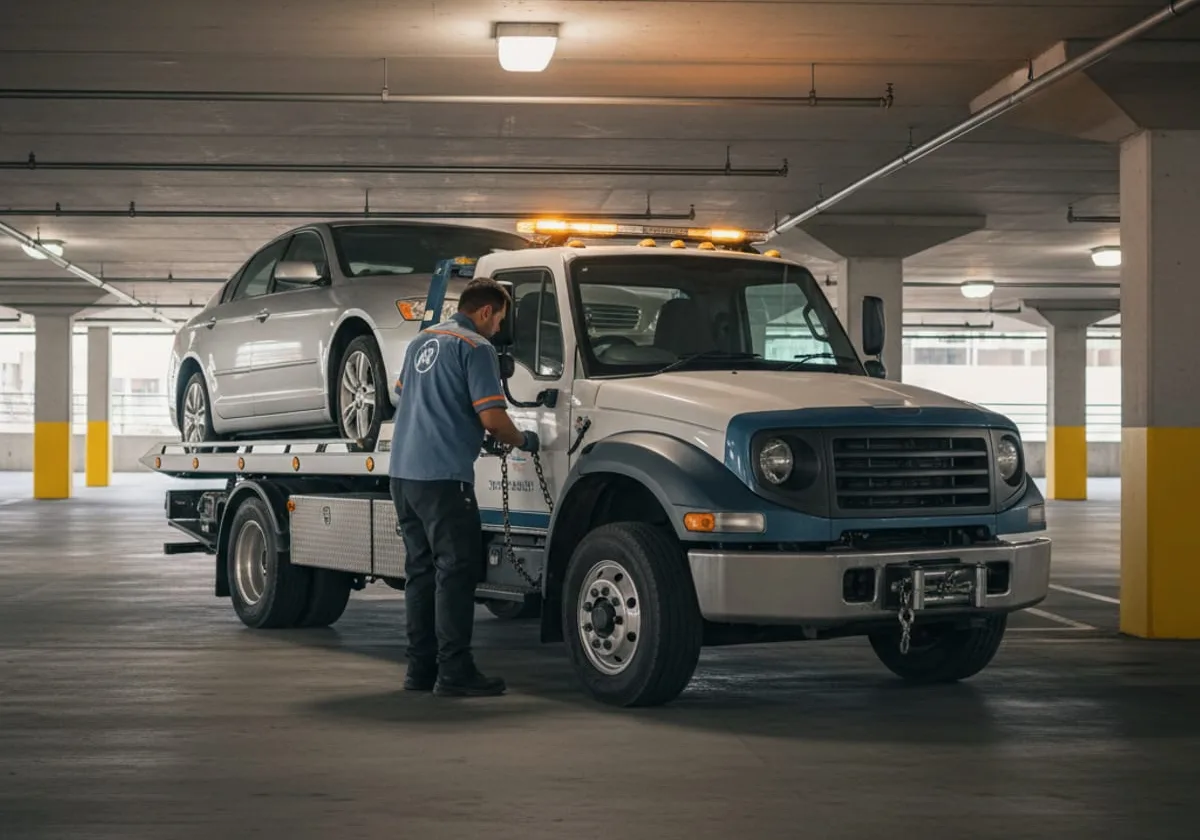
A wheel-lift can often tow a front-wheel-drive car with its front wheels raised. The correct setup still depends on the model, transmission, damage, and condition of all four wheels. The owner’s manual gives the final instructions for that vehicle.
How front-wheel drive affects towing
A front-wheel-drive car normally sends engine power through its front wheels. Those wheels connect to important drivetrain parts, including the transmission and drive axles. That layout affects which end an operator lifts.
For many front-wheel-drive vehicles, the usual wheel-lift position raises the front end. The rear wheels then roll on the road. This keeps the driven wheels from turning during the trip.
That doesn’t make one setup correct for every car. Some vehicles have special towing limits. A hybrid or electric model may also require a different procedure. Transmission type, ground clearance, and electronic parking systems can affect the choice.
The vehicle’s condition matters just as much as its drivetrain. A front-wheel-drive sedan with four intact wheels presents one situation. A car with collision damage, a locked rear wheel, or loose suspension parts presents another.
Road position also changes the job. A disabled car on Buford Highway gives an operator more room than one blocking the Downtown Connector. Tight parking decks near State Farm Arena can also limit truck access and turning space.
Tell dispatch that the car is front-wheel drive, but don’t stop there. Share the exact year, make, model, and current condition. That information helps the operator plan the pickup and select suitable equipment.
Our wheel-lift towing service connects Atlanta drivers with independent operators. The operator evaluates the vehicle and follows its approved towing instructions before moving it.
When the driven wheels must stay raised
The driven wheels generally stay off the road during wheel-lift transport when the manufacturer doesn’t approve rolling them. On a front-wheel-drive car, that usually means lifting the front wheels.
Turning driven wheels can rotate connected drivetrain parts. Whether that rotation is permitted depends on the vehicle’s design. Neutral gear alone doesn’t prove that road contact is acceptable.
This distinction matters when a car won’t start. The transmission may not shift normally. A dead battery can also prevent an electronic shifter or parking brake from releasing. Collision damage may leave a wheel pointed sideways or pressed against the body.
Don’t force a shifter, steering wheel, or parking brake to prepare the car. Tell the operator what isn’t moving. That detail may change the loading method or equipment needed.
A wheel-lift also needs a sound pair of wheels to remain on the pavement. The tires must be suitable for rolling, and the wheels can’t be locked or badly damaged. If the rear axle can’t roll freely, raising only the front may not work.
Atlanta traffic can add another constraint. A disabled vehicle near Spaghetti Junction or the Brookwood split may be in an exposed position. On metro freeways, GDOT HERO clears hazards and helps stranded drivers, but it doesn’t tow a vehicle to a repair shop.
Move away from traffic only when you can do so safely. If the car is creating an immediate roadway danger, call 911. Let the responding operator handle the vehicle setup.
When dollies or a flatbed may be needed
Dollies support wheels that shouldn’t roll on the pavement. They may allow an operator to use a wheel-lift when the second axle can’t safely remain on the road. The exact setup depends on the vehicle and available clearance.
A flatbed carries the entire vehicle off the road surface. That can be the better method when no wheels should roll, the car has significant damage, or its manual calls for platform transport.
Low ground clearance can also affect the decision. A bumper, exhaust part, battery enclosure, or body panel may sit too close to the pavement during a wheel-lift tow. Changes such as lowered suspension or an aftermarket body kit need to be disclosed before dispatch.
Wheel condition matters too. A missing tire, broken wheel, seized brake, bent suspension part, or steering problem can rule out a basic two-wheel setup. Visible leaking fluids or loose components also deserve mention.
Dollies aren’t interchangeable with a flatbed. They solve certain wheel-contact problems, but space and vehicle condition still control their use. A tight garage in Midtown or Buckhead may accommodate one truck type better than another. An open shoulder on I-285 presents different access concerns.
A front-wheel-drive badge also doesn’t rule out added systems. Some models have all-wheel-drive variants with nearly identical names and bodywork. Confirm the exact trim instead of relying on appearance. For that drivetrain, our guide to flatbed versus wheel-lift towing for an AWD car explains the added concerns.
When full platform transport is appropriate, our flatbed towing service can match you with an independent local operator. The operator confirms the loading method after reviewing the car and its surroundings.
What vehicle details to share before dispatch
Good information prevents the wrong equipment from reaching the pickup. Start with the vehicle’s year, make, model, and trim. If you know the drivetrain, say whether it’s front-wheel drive, rear-wheel drive, or all-wheel drive.
Then describe what happened. A stalled engine is different from a curb strike. A flat tire is different from suspension damage after a crash. Tell dispatch whether the car starts, shifts into neutral, steers, and rolls.
Share any warning shown on the dashboard. You don’t need to diagnose it. Read the message or describe the symbol without guessing what failed.
Mention each damaged or locked wheel. Identify whether it’s at the front or rear. Also report loose panels, leaking fluids, deployed airbags, and parts touching the ground.
The pickup location matters. Give the road name, direction of travel, and nearby exit when possible. On GA-400, I-20, I-75, or I-675, the travel direction can affect access. In a garage, share the entrance clearance and level. At an apartment complex, give the building or gate details.
Tell dispatch where you want the car taken. The destination may affect the equipment plan, especially for a longer trip across the metro. Quick Tow ATL serves Fulton, DeKalb, Cobb, Gwinnett, and Clayton counties. Outer-ring trips can also be matched for long-haul service.
Before calling, gather:
- The exact year, make, model, and trim
- The drivetrain shown in the manual or vehicle information
- The condition of all four tires and wheels
- Whether the car starts, steers, shifts, and rolls
- Any collision, suspension, or underbody damage
- Your pickup position and destination
- Parking-deck clearance, gate, or access restrictions
If you’re uncertain about any detail, say so. An accurate “I don’t know” is more useful than a confident guess.
Why the owner’s manual gets the final say
The owner’s manual is the controlling source for your car’s towing method. It reflects the vehicle’s exact drivetrain, transmission, and manufacturer procedures. General advice can’t account for every model year or trim.
Look for sections named “towing,” “emergency towing,” “vehicle transport,” or “roadside assistance.” Don’t rely only on a section about recreational towing. That material may address towing behind a motorhome, which can involve different conditions.
Read the instructions for your exact drivetrain. A model family may include front-wheel-drive and all-wheel-drive versions. Hybrid, plug-in hybrid, and electric versions may have their own transport rules.
The manual may specify which wheels can touch the road. It may instead call for all four wheels to remain raised. Follow its stated limits and procedures without substituting a method from a different vehicle.
If the printed manual isn’t in the glove box, check the manufacturer’s official owner resources. Use the vehicle identification details to select the correct model year and version. Avoid treating an online forum post as the final instruction.
Share the relevant manual language with dispatch. A photo or screenshot can help the operator review it before arrival. The operator still needs to inspect the vehicle because damage may make the normal method unsuitable.
When the manual and the scene point toward different concerns, choose the method that avoids unsupported movement. A routine front-wheel-drive setup no longer applies when wheels are locked, suspension is broken, or the body can’t clear the pavement.
When to call us
Call when the car can’t be moved safely under its own power or its towing method isn’t clear. The line takes calls 24 hours a day, and an independent local operator gets dispatched after the vehicle details are reviewed. Call us at (404) 476-5878.